


Hunt of the Unicorn
When I was a child the 1982 film based on Peter S Beagle story "The Last Unicorn" was one of my favorite movies. Like everything else I have encountered in life that I liked a little more than usual, I became obsessed with unicorns and would get any book I could find at the library that featured a unicorn
It was in my elementary school library of all places that I encountered a book that enthralled me, an entire book on the Unicorn Tapestries. A gorgeous series of highly detailed woven tapestries depicting the hunt of a unicorn, these same tapestries were used as inspiration for the opening title sequence of the film. Me as a child took this as proof that at some point unicorns were very real, why else would the royal coat of arms for the UK have a unicorn on it?
The tapestries have stuck with me all these years, just as beautiful art pieces, The amount of effort put into them is staggering, and the fact that they have been preserved so well is amazing. But then I got to wondering, what exactly is the story behind them? And turns out, we're not 100% sure
_%E2%80%93_467638.jpg)
Episode: File 0157: The Bog Unicorn Tapestries
Release Date: Nov 28 2025
Researched and presented by Cayla
The Tapestries
First thing I have to show you is the tapestries themselves


The tapestries comprise five large pieces, one small piece, and two fragments that appear to have been one piece. They are thought to have been designed in Paris and made between 1490-1505 in Brussels
They tell the story of the hunt, the first showing hunters and their dogs in the woods, the second they come across the unicorn who is putting its horn in the water surrounded by its animal friends, it's thought that the unicorn is purifying a poisoned water source. Third the hunters go to attack the unicorn but it escapes, fourth the unicorn fights back. The fifth only exists in two pieces, but seems to show a young woman approaching the unicorn it's theorized that the hunters couldn't capture the unicorn so instead baited it with a fair maiden. 6th depicts the unicorn as dead, thrown over the back of horse. And the 7th shows a unicorn in a fenced field, chained to a pomegranate tree
Today they live in the Metropolitan Museum, but ever since their discovery there has been intense scholarly debate about the origins of these tapestries, an enduring mystery for the ages
History of the Unicorn
The first stop in our journey is the history of unicorns. They're creatures plausible enough to may have existed (without the magical abilities), but if they had you would think there would be fossils or remains somewhere. But instead most evidence seems to point to the unicorn as the result of the weirdest multi century game of shitty telephone
"Indika" by
Greek physician Ctesias
The first written description of a creature that sounds like a unicorn comes from the book "Indika" by Greek physician Ctesias, written in the 5th century BC. It is also the first book about India. The description therein states:
In India there are wild asses as large as horses, or even larger. Their body is white, their head dark red, their eyes bluish, and they have a horn in their forehead about a cubit in length (about 28"). The lower part of the horn, for about two palms distance from the forehead, is quite white, the middle is black, the upper part, which terminates in a point, is a very flaming red. Those who drink out of cups made from it are proof against convulsions, epilepsy, and even poison, provided that before or after having taken it they drink some wine or water or other liquid out of these cups. […] There is only one way of catching them. When they take their young to feed, if they are surrounded by a large number of horsemen, being unwilling to abandon their foals, they show fight, butt with their horns, kick, bite, and kill many men and horses. They are at last taken, after they have been pierced with arrows and spears; for it is impossible to capture them alive. Their flesh is too bitter to eat, and they are only hunted for the sake of the horns and huckle-bones - Indika

Pretty weird fucking unicorn. Though it's important to add that Ctesias never went to India. He was Court Physician in Persia, and this book is a compilation of stories he heard from traders. There is a lot in this book that does not hold up as fact, but there is some that does
Among the more peculiar claims of Indica were the stories of a race of people with only one leg, or with feet so big they could be used as an umbrella
Many suspect the creature described here is a rhino, which were native to India, but were not white, red or black, but the Indian Rhino's horn can grow to about 22" so that's close. But I also couldn't find any information on whether or not rhinos are capable of kicking. How much he was embellishing these stories or how much he understood them when they were told to him is all up for debate
Aristotle Historia Animalium II 400-300 BC
Fast forward a century or so sometime between 400-300 BC and Aristotle takes a stab at it with his Historia Animalium II and in it describes the "Indian Ass"
"the Indian ass have a single horn and are solid-hoofed" - Historia Animalium
That's pretty much it. And like Ctesias, Aristotle was mostly working off story and rumor. But Aristotle's work would go on to influence zoology until the 16th century. This gives you an idea of why so many medieval era bestiaries had some absolutely wild takes about animals
Julius Caesar 58-49 BC "Commentary on the Gallic War"
Our next take comes from an unusual place: Julius Caesar
Some time between 58-49 BC, he wrote a series of 8 books called "Commentary on the Gallic War" this was while he was in Europe chasing the Galls around.
the mention of a unicorn-like creature comes up in the 6th book. He is discussing the Hercynian forest which had been an ancient and dense forest that once stretched across Western Central Europe, from Northeastern France to the Carpathian Mountains, including most of Southern Germany. Now only pieces remain, which include some of Europe's most famous forests like the Black Forest and Bavarian forests of Germany.
Caesar describes its size as such
The breadth of this Hercynian forest, above mentioned, is as much as a nine days' journey for an unencumbered person […] There is no man in the Germany we know who can say that he has reached the edge of that forest, though he may have gone forward a sixty days' journey, or who has learnt in what place it begins. - Commentary on the Gallic War
And like all deep dark and ancient forests, there are legends
It is known that many kinds of wild beasts not seen in any other places breed therein, of which the following are those that differ most from the rest of the animal world and appear worthy of record.
There is an ox shaped like a stag, from the middle of whose forehead between the ears stands forth a single horn, taller and straighter than the horns we know. From its top branches spread out just like open hands. The main features of female and of male are the same, the same the shape and the size of the horns. - Commentary on the Gallic War
Some scholars believe that Caesar may be referring to a reindeer, though reindeer do have two separate antlers, but it is possible for creatures from the cervidae family (re: deer/elk/reindeer) to have abnormal antler development where only one antler may grow, and most species shed their antlers on a yearly basis, and that shedding may not happen simultaneously. Cervidae also regularly joust with each other and antlers can break in these fights
It is easy to see how a reindeer with a single antler could match this description


Pliny the elder's Natural History ~77AD
And of course we can't talk about anything remotely biology related without Pliny having a take. His series "Natural History" was first published in 77AD, and consisted of the 37 books with only 10 being published before his death, the remainder then being published by his son, Pliny the Younger
But the most furious Beast is the Monoceros: his Body resembleth an Horse, his Head a Stag, his Feet an Elephant, his Tail a Boar; the Sound he utters is deep ; there is one black Horn in the Middle of his Forehead, projecting two Cubits in Length (3 ft) : by Report, this Wild Beast cannot possibly be caught alive - Natural History
Pliny's description sounds a lot like Ctesias' and is likely very strongly influenced. He even has a section on the "one legged people" he calls a "sciapod". Everything here could easily be read for a rhino, except the head like a stag
Aelian - Characteristics Of Animals 175-235 AD
Lived between 175-235 AD. Aelian brings the most expansive description of the "Indian Ass" while citing Ctesias, he expanded significantly on the lore, though it's not clear his source
I have learned that in India are born wild Asses as big as horses. All their body is white except for the head, which approaches purple, while their eyes give off a dark blue colour. They have a horn on their forehead as much as a cubit and a half long; the lower part of the horn is white, the upper part is crimson, while the middle is jet-black. From these variegated horns, I am told, the Indians drink, but not all, only the most eminent Indians [..].
And they say that a man who has drunk from this horn knows not, and is free from, incurable diseases: he will never be seized with convulsions nor with the sacred sickness,' as it is called, nor be destroyed by poisons. Moreover if he has previously drunk some deadly stuff, he vomits it up and is restored to health. […]
Their knucklebones are said to be black, and if ground down are black inside as well. And these animals are far swifter than any ass or even than any horse or any deer. […]
When the dame gives birth and leads her new-born colts about, the sires herd with, and look after, them. And these Asses frequent the most desolate plains in India. So when the Indians go to hunt them, Asses allow their colts, still tender and young, to asture in their rear, while they themselves fight on their behalf and join battle with the horsemen and strike them with their horns.
Now the strength of these horns is such that nothing can withstand their blows, but everything gives way and snaps or, it may be, is shattered and rendered useless. They have in the past even struck at the ribs of a horse, ripped it open, and disembowelled it. For that reason the horsemen dread coming to close quarters with them, since the penalty for so doing is a most lamentable death, and both they and their horses are killed.
They can kick fearfully too. Moreover their bite goes so deep that they tear away everything that they have grasped. A full-grown Ass one would never capture alive: they are shot with javelins and arrows, and when dead the Indians strip them of their horns, which, as I said, they decorate. But the flesh of Indian Asses is uneatable, the reason being that it is naturally exceedingly bitter. - Characteristics Of Animals
Again, most of this can be read for a rhino, though the multi colored horn, purple head and blue eyes are something. Rhino horn has a long history of being thought to cure all maladies and neutralize all manner of poisons, there are still those that believe it today, which is why rangers in wildlife reserves have been forced to remove the horns of their rhinos to remove the temptation for poachers
550 AD Cosmas Indicopleustes
Then around 550 AD an Egyptian monk named Cosmas wrote a book
The Monoceros or Unicorn: This animal is called the unicorn, but I cannot say that I have seen him. But I have seen four brazen figures of him set up in the four-towered palace of the King of Ethiopia. From these figures I have been able to draw him as you see. They speak of him as a terrible beast and quite invincible, and say that all his strength lies in his horn. When he finds himself pursued by many hunters and on the point of being caught, he springs up to the top of some precipice whence he throws himself down and in the descent turns a somersault so that the horn sustains all the shock of the fall, and he escapes unhurt - Christian Topography
In the original version of Cosmas' manuscript he drew a picture of the unicorn, but that manuscript is long lost. But an 11th century reproduction of the book also reproduced the sketch and is as close as we'll likely get to seeing the original
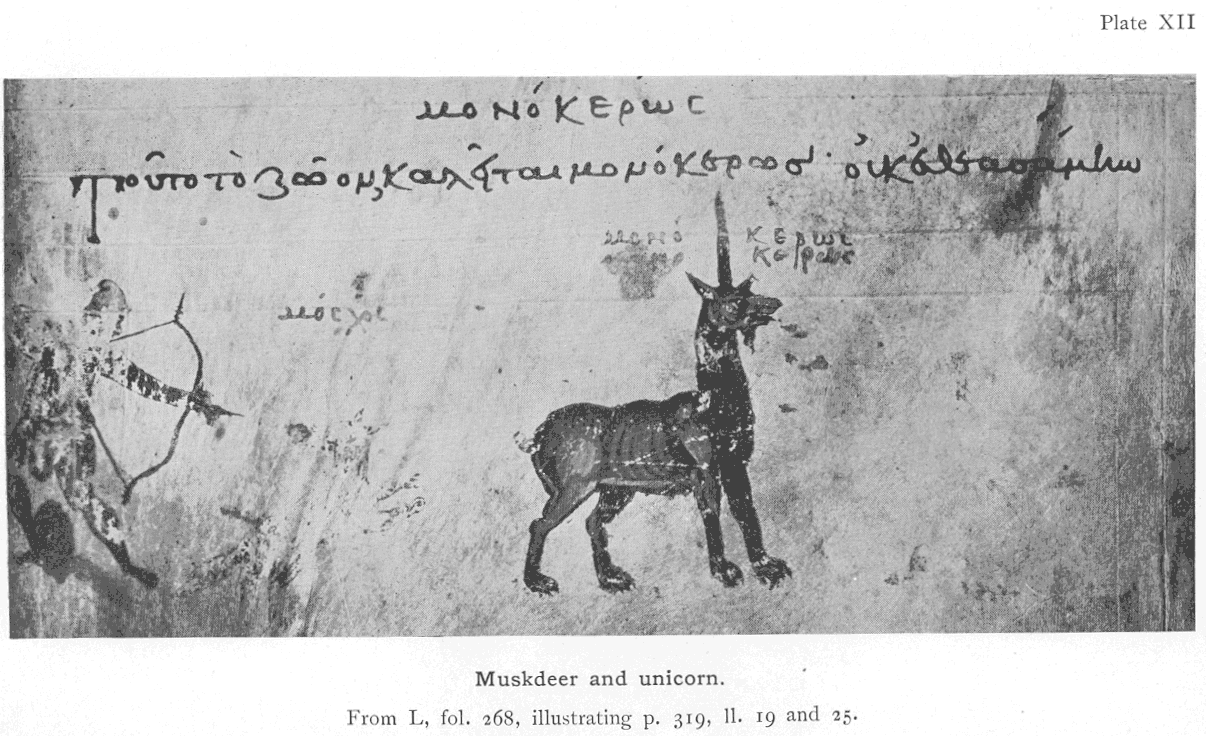
This illustration does look like a fucking unicorn, not a rhino. To make things even more interesting, Cosmas has an entry in this book on Rhinoceros and he has indeed seen one of those and he also drew it. This is then the first piece of text that clearly identifies a unicorn and a rhino as two separate creatures. Though his drawing of a rhino is very horse-like. He did say he only saw it from a "safe distance"
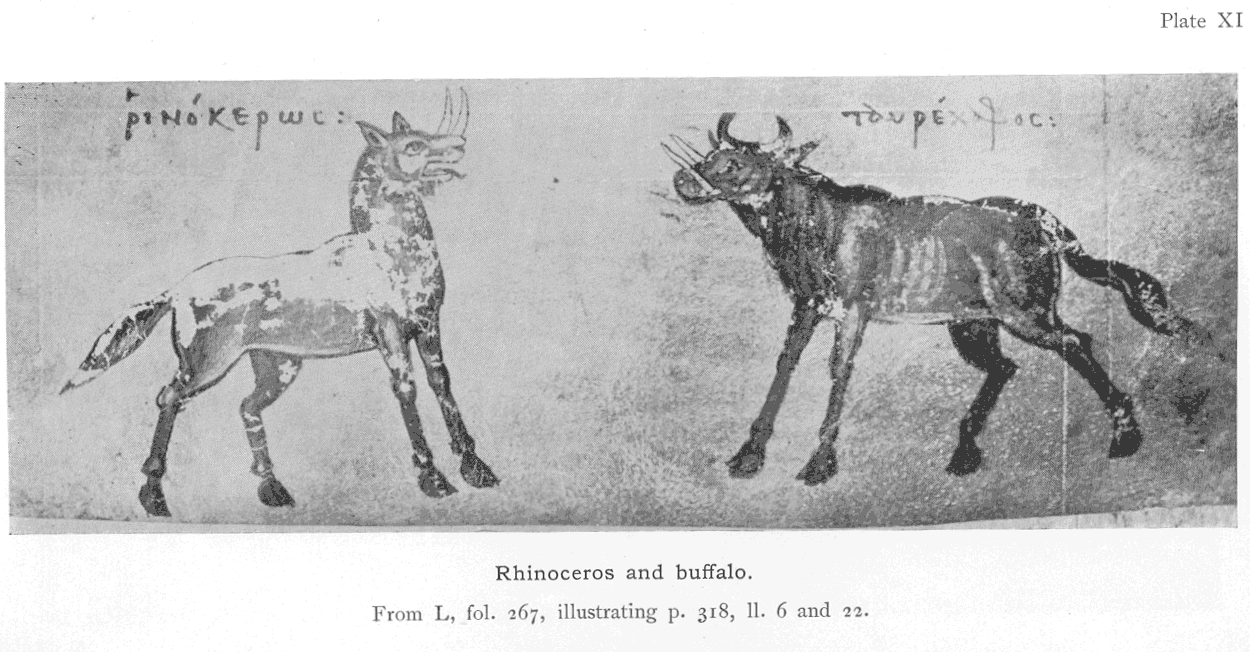

So if we are to assume this was an accurate recreation of Cosmas's original drawing, and an accurate representation of what Cosmas saw at the palace of the King of Ethiopia, this could very well be the unicorn we know now
But Cosmas didn't stop there
What I didn't tell you was the title of this book was "Christian Topography" and now this is where Jesus comes in
Unicorns and God
In many modern versions of the bible you will find unicorns mentioned multiple times
Job 39:9-12: Will the unicorn be willing to serve thee, or abide by thy crib? Canst thou bind the unicorn with his band in the furrow? or will he harrow the valleys after thee?
God brought them out of Egypt; he hath, as it were, the strength of a unicorn.
Save Me from the lion's mouth; for Thou hast heard Me from the horns of the unicorns.
It is argued that unicorn is a mistranslation of the hebrew term re'em, also reëm. The re'em is mentioned 9 times in the Hebrew bible (though I can't tell you what editions) but most linguists agree the closest translation is oryx or wild bull. But somewhere down the line someone decided that unicorns were pretty neat and wanted that up in their Christian mythos
Of note the white oryx does match some of the descriptions down to its black ankles, including that both male and females have horns, the only thing that really doesn't is it typically has two horns. But unlike other deer-like critters, Oryx don't regrow their horns if they lose one

The earliest translation to explicitly contain unicorn in it that I can find is the 1395 Wycliffe translation, but it appears to go back much further
Saint Basil 330-379 AD
Margeret B Freeman was a caretaker at the Met Museum and one of her areas of care was what is known as the "cloisters" and this is where the unicorn tapestries are held. She too became obsessed with them and wrote a whole book. In it she claims that Saint Basil made a statement somewhere in 300-379 AD that Christ "will be called the Son of unicorns, for as we have learned in Job, the unicorn is irresistible in might and unsubjected to man."
He notes that the horn is frequently used in the Scriptures to denote glory and power and salvation, and adds : "Christ is the power of God, therefore he is called the unicorn on the ground that He has one horn, that is, one common power with the Father." - The Unicorn Tapestries
This may be the earliest biblical connection, but this guy really was all in on unicorns
Going forward anything that mentions unicorns would also mentioned their connection with Christ, the two become intrinsically linked, at least in the Christian world
The Virgin - Physiologus ~800
Of course now that Christianity is involved, along comes purity.
Physiologus became known as the Christian bestiary, though it was originally written in the 2nd century AD in Alexandria, we don't know who wrote it. But it became such a celebrated text, much like the bible, it has been translated and re-released a thousand times since with new chapters being added.
By the 9th century edition unicorns show up and with it, virgins.
There is an animal that is called a monoceros in Greek and in Latin truly a unicorn. Physiologus says that the unicorn has this nature. He is a small animal, like a kid, but exceedingly fierce, with one horn in the middle of his head; and no hunter is able to capture him. Yet he may be taken in this manner: men lead a virgin maiden to the place where he most resorts and they leave her in the forest alone. As soon as the unicorn sees her he springs into her lap and embraces her. Thus he is taken captive and exhibited in the palace of the king.
In this way Our Lord Jesus Christ, the spiritual unicorn, descended into the womb of the Virgin and through her took on human flesh. He was captured by the Jews and condemned to die on the cross. […] - Physiologus
So yeah, like a unicorn to a virgin maid, spirit Jesus was drawn to Mary and got all up in her lap, but overshot I guess?
1100

There are variations upon the virgin myth that pop up over time, one of my favorites in particular comes from a 12th century bestiary by Anglo-Norman poet named Philippe de Thaun :
When a man intends to hunt it, and to take it and ensnare it, he goes to the forest where is its repair, there he places a virgin, with her breast uncovered, and by its scent the unicorn perceives it; then it comes to the virgin and kisses her breast, falls asleep on her lap and so comes to its death. The man arrives immediately and kills it in its sleep ... or takes it alive - Philippe de Thaun
A french writer known only as Pierre would write a bestiary for Philippe de Dreux, bishop of Beauvais sometime between 1175-1217 is the first to say the unicorn is beautiful
and his horn is four feet long, straight, and sharp. Following Pliny and not the Physiologus, Pierre states that the unicorn has the body of a horse with the head of a stag, but he adds that he is "not a very large beast." -
Most bestiaries say the virgin maiden must be left on their own, but the abbess Hildegard von Bingen (1098-1179) suggests that to capture a unicorn several maidens are better than one
'On the day of the hunt, men, women, and girls pursue the unicorn. Then the girls separate from the others and play among the flowers." The girls should be "well born, not rustics," and neither too young nor too old. "The unicorn ... on seeing the girls . . . stops at once . . . crouches on his hind legs and inspects them for a long time. ... He falls in love with them, for he perceives that they are enticing and delightful." - Hildegard von Bingen
In the torn tapestry that shows a woman and the unicorn, the arm of another woman can be seen stroking the unicorn
But it wasn't just the pious who were interested in the unicorn, it was also the horn
The trouvere Thibaut, Count of Champagne (1201-53), composed this song to his lady:
The unicorn and I are one :
He also pauses in amaze
Before some maiden's magic gaze.
And while he wonders, is undone.
On some dear breast he slumbers deep
And Treason slays him in that sleep.
Just so have ended my life's days;
So Love and my Lady lay me low.
My heart will not survive this blow.
The Horn
That's unicorn the symbol, but unicorn the alleged physical creature on the other hand. We already know that apparently its flesh was bitter so no good for eating, but even from the earliest of days, even before Jesus got involved, Unicorn horns were magical cure-alls and you know the rich and the powerful were all over that.
Many a noble and royal claimed to have cups or items made with unicorn horn, unsurprisingly all that have been tested have turned out to be narwhal horn.


In the Middle Ages it sold for several times its weight in gold and was considered among the greatest treasures for a cathedral, monastery, or palace.
Unicorn Art
Unicorns are pretty cool looking and everyone noticed. Not only were they cool, they were a-ok with god. So you could be all about that and just say "I just love Jesus so much" and no one would bat an eye. So unicorns got put on everything


Unicorns being associated with jesus and purity led to unicorns being associated with true love. And what better way to express your love for someone than to kill a bunch of animals and have them fashioned into a box while carving the murder of a unicorn on it and giving it to them


#/media/File:French_-_Casket_with_Scenes_of_Romances_-_Walters_71264_-_Left.jpg)
Here is a box made of ivory thought to have been made between 1330-1350. It was one of 8 that have survived
In France these boxes are thought to have been given as a token of affection and may have been a part of medieval courtship, the scenes depicted on them are famous scenes from romantic stories that were common at the time and among them we see the unicorn. They were about the size of a jewelry box and thought to have held valuable trinkets, love letters or other small tokens of personal importance
On the left side of
the panel, forbidden lovers Tristan and Isolde (from the legends of King
Arthur) meet for a secret rendezvous. They are foiled, however, by Tristan's
uncle, King Mark, who spies on them from between the branches of the tree.
Luckily, Tristan and Isolde see King Mark's reflection in a pool of water, and
so pretend to be "just friends." [..]
To the right of this scene of unrequited love, a more violent episode occurs. A
maiden holds a chaplet [a wreath of flowers, a symbol of romantic commitment)
in her right hand. With her left hand, she cradles the head of a unicorn.
Unfortunately for the unicorn, a hunter has snuck up behind him, and has
pierced him through with a spear. It may seem strange to us, as contemporary
viewers, that for a medieval viewer, this violent image of the capture of a
mythical creature was symbolic of love
[..]
Taken together, the scenes
of Tristan and Isolde's romantic tryst and the death of the unicorn present to
viewers two opposing versions of love. Whereas Tristan and Isolde exemplify
romantic, physical, and forbidden love, the unicorn represents a Christian's
pure love for Christ as Savior, a love meant to last beyond the mortal world. - Smart History

1484-1488
Translation: Let God arise and let His enemies be scattered
The Tapestries
While the unicorn tapestries that brought us here are gorgeous they are far from the only ones to depict the creature
Today nearly all surviving tapestries containing unicorns are held at the Met Museum, but they report on records indicating they were once much more plentiful (perhaps not unlike the unicorn)

(right) An illustration of a now gone unicorn tapestry
François Roger de Gaignières (1642–1715). A Tapestry Depicting a Lady and a Unicorn with the Device of Charles II, Duke of Bourbon (1434–1488). France, ca. 1680–90. Watercolor. Bibliothèque Nationale de France, Paris (Pc-18-fol)

The Lady and the Unicorn
"Touch, taste, smell, hearing and sight... These six tapestries, woven in around 1500, represent the five senses against a detailed red background.
The remaining sixth sense, explained only by the inscription "À mon seul désir" (To my only desire), has inspired countless theories. Without excluding a possible meaning in the register of courtly love, it could be a reference to free will: the woman with her decorative headdress and refined clothing, renouncing temporal pleasures."


These are huge btw all have widths and lengths over 10 ft. The lion and unicorn bear the shields or heraldry of the Veste family which is who is thought the tapestries were made for

The tapestries were lost until 1841 where they were found in a castle in poor condition, suffering from water damage and mold and had to be painstakingly and meticulously restored
Just who made The lady and the unicorn also remains a mystery – though some questions can be answered. Today it is believed the tapestries are among a group of works originating from the Paris workshop of the Master of Anne of Brittany.
And apparently unicorns weren't just fun to look at . Unicorns were seen as fashionable, playful, and powerful creatures, qualities that prominent men aspired to possess themselves. For special occasions, noblemen even found childlike joy in donning unicorn costumes
The Unicorn Tapestries
Now to bring it all back around to what started this, the mystery of the Unicorn tapestries, who made them and why?
The list of persons directly responsible for the making of the Unicorn Tapestries, if such a list existed, would undoubtedly be a long one. First of all there would be the man or woman who conceived the idea for the general subject matter and for the details of the story. Then there would be the designer or designers who drew the preliminary sketches {petits patrons) and the painter who executed the full-scale patrons or cartoons on large linen sheets or on strips of paper pasted together. There would be the dyers of the fine silk and woolen threads and those who prepared the metallic threads by winding strips of silver or gilded silver around strands of silk, all to be used as the wefts for creating the designs. There would be the workmen who set up the enormous looms with heavy, undyed woolen warps, and the many weavers who worked side by side on these looms day after day with their bobbins of colored wools and silks, producing in textile form the scenes in the painted cartoons. And, of course, there would also be the wealthy patron who commissioned the tapestries and paid for the well-done, certainly expensive job.- Margaret B Freeman - The Unicorn Tapestries
Tapestries
Tapestries rose to prominence in the 14th century. Based on recovered household inventory charts from "princely" estates it would seem it pretty common for someone of that level of wealth and influence to have a couple tapestries in their households, frequently embellished with the family's coat of arms, usually for the purpose of furnishing a bedroom or some great room of some kind they could show it off
Medieval tapestries were massive, meant to cover walls floor to ceiling in their entirety, so custom order ensured it fit the walls you wanted to put it on. There are records of tapestries being as big as 15 ft tall and 132 ft long
Tapestries also got bonus points over other artforms in that it was portable. You could pack up your tapestry and bring it to a friend's for a party
Now the subjects of a given tapestry varied a lot based on the intended audience (and patron). Sometimes they are meant to be statement art pieces, or demonstrate the owner's love for god. Sometimes they were supposed to be fun, sometimes they represented real events/people others fantastical.
The quality of the Unicorn tapestries is also a big factor to consider, the complexity, the use of silver and gold threads, the numbers of colors and the skill used marks them as incredibly well made and likely incredibly expensive to have made.
So what this tells us is the creators were:
- Very well off
- Had somewhere with 15 ft walls and lots of space
- Really liked unicorns. This set is 7 pieces after all
What We Do Know
What we know of the history of the tapestries is as follows
the tapestries are thought to be designed between 1490-1505 based on the style of not just the illustration but of the clothing worn by the subjects therein
But the first records of the tapestries don't appear until 1680, nearly 200 years after their creation. At this time they belonged the Le Rochefoucauld family. The Le Rochefoucaulds are one of France's oldest noble families dating back to the 10th century. At the time of the tapestries making they would've just been lowly Counts, but by 1680 they were Dukes.
In 1680 the current head of the house Duke Francois de le Rochefoucauld VI would die, triggering an inventory of all his belongings. When he passed he was living in a townhouse in Paris and among all his possessions was the full 7 set of the Unicorn Tapestries. The inventory lists estimated value of the items and for the entire set it was valued at 1500 livres. which converts to roughly $45,000 US dollars today. Remember this 200 years after they were made
This record also listed the length of the tapestries to be 84 ft when combined, where what remains today is roughly 70 ft, indicating 14 ft of material has been damaged or was removed at one point or another since then, obviously the 5th tapestry that only remains as two small fragments would make up much of that missing 14 ft, but it's estimated that each of the tapestries likely lost a foot of width over time.

The height for the tapestries was listed at 15 ft "thereabouts" which isn't the most exact measurement, but considering the tapestries are currently 12 ft in height it would imply that some height has also gone missing
We have no way of knowing what the missing pieces contained, but it was common for tapestries like this to have text along the top or bottom explaining what is happening in the image. But lettering is known to be one of the first things to go as a tapestry deteriorates and if they become illegible then it could be the owners chose to remove those parts
The tapestries were found hung in his bedroom, indicating them to be very prized possessions, so it's little surprise when in 1728 when the family now lived in Chateau of Verteuil the tapestries appeared again.
At this time though the inventory only listed 5 of the 7 tapestries, evaluated at 605 livres, which is roughly $10,000 today. The inventory noted that the tapestries were in disrepair, worn and torn in places. Despite their state, in the entire family inventory the only tapestries worth more than this was a set of 11.
In 1789 the French Revolution would begin and would go on for ten years. The country had been in crisis, its common people starving and struggling to make ends meet and those in power had grown complacent at best, corrupt at worse.
The La Rochefoucaulds of course played their part, Duke Francois, the 7th duke of the family was known for trying to meet in the middle, pushing for reform from within the system. After the storming of Bastille in a meeting with Louis XVI who was calling the whole thing a revolt, the duke famously said "No, majesty, it's not a revolt. It's a revolution" which is a pretty badass quote to be remembered for. Also he was pro vaccinations, establishing a dispensary in Paris
But like many a chateau the le Rochefoucauld was raided. Many things in the home were destroyed but the tapestries were spared, as a directive had been given out to only destroy things that showed signs of royalty. In 1793 the tapestries were looted
In the 1850s the La Rochefoucauld family began to search for the things that had been looted from their estate in hopes of buying them back. A peasant's wife told them that her husband had some "old curtains" that were covering some vegetables in the barn that might be of interest and sure enough they would turn out to be the unicorn tapestries. The family purchased them back and had them restored before hanging them again in the chateau in 1856
There's not a ton of information about what the damage to the tapestries was during this time or how extensive the repairs, but it is assumed that the damage to the 5th panel likely occurred around this time

In 1922 the six complete tapestries were sent to New York to be put on display, where they would be purchased in 1923 by John D Rockafeller for $1 million. In 1937 he would donate the tapestries to the Metropolitan Museum where they have hung since (aside from a short stint during WW2 after the attack on Pearl Harbor where they were packed up and sent out of New York for their safety)
Of note the La Rochefoucauld family chateau became occupied by the German army during the war and there's a chance if the tapestries had remained they may have disappeared forever in some Nazi asshole's collection
The museum would contact the La Rochefoucauld family (Count Gabriel de La Rochefoucauld,) in hopes of finding out more about the tapestries who advised them that if they were interested the family had two fragments of what was the 5th tapestry in the set saying his father had kept the pieces as a souvenir, which of course they were.
The La Rochefoucaulds aren't sure of the origins of the tapestries either but they have theories
What We Don't Know
That's all way have for external clues, but looking at the tapestries there are a lot of hidden clues that might tell us more
Who Made it?
One of the strange things is, while the tapestries clearly look to have been done by the same artist with the same materials and done as a sequence, when you look closer you notice things that don't line up
One is the castle in the background


But not just that, not one of the people appear twice, every piece has a unique cast of characters with different hair colors, styles, hats and tunics, not even the maiden that lures the unicorn is the same
When tapestry makers planned their designs they would make one or more sketches referred to as a 'petit patron'. Few of these sketches have survived, but the Met Museum suspects that the same design for the unicorn in the "Sight" tapestry of the Lady and the Unicorn and the "The Unicorn Surrenders to a Maiden" in the hunt series potentially hinting at being from the same workshop or a shared sketch

Throughout the hunt there are many repeating small details like rabbits and dogs in the same poses and angles, like a tattoo artist doing flash art, tapestry artists may have drawn each figure separately and then assembled them into a scene, sometimes repeating them
[Petit patron sketch of the massive "The Great History of Troy" tapestry set. It was said to have consisted of 11 pieces and unfortunately none survived to today, so the sketch is all that remains]


Weavers were many, with clusters of workshops in every major city. It's thought that the persons who did the weaving wasn't the same person doing the designs and that designs may have been shared between different workshops (or even stolen). Many of the designs of these unicorn tapestries are reminiscent of work by the painter Jean D'Ypres in the early 1500s, known for doing work in service of royalty and he came from a line of painters, his father, grandfather and brother were all reasonably well known artists of their time so may have contributed to the design of the tapestries
Its Subject
The hunt of the unicorn echoes a much older visual story common to see in art from the period, which was the hunt for the stag. Whether a single image or a series of tapestries, the unicorn hunt follows nearly beat for beat though obviously a maiden isn't used to lure the stag, and not every depiction of the hunt shows the stag fighting back. Another difference is the hunt for the stag will often depict the animal being butchered and only parts brought back, where with the unicorn hunt we see the whole animal was brought back. Whoever had this commissioned liked unicorns enough to replace the whole target of the hunt in a unique set of pieces

This is particularly interesting as this one of only two art pieces in existence that depict the hunt of the unicorn this way
60 years after the tapestries would've been made, a set of engravings were made by Jean Duvet commissioned by King Henry II for his mistress Diane de Poitiers (who was apparently so influential that many consider pretty much a queen in everything but the title). It's possible Duvet had seen the tapestries, or that King Henry had, as his father had been Francois I who was the godson of Francois de La Rochefoucauld and had a close relationship with the family

These elements combined make for a pretty unique set of pieces and for no others like it to have existed as far as we know, could speak to the exclusivity of the commission.
Coat of Arms and Monograms
As mentioned, it was common for tapestries to be made contained the coat of arms or names of those they were intended for, but with the unicorn tapestries, there are no coat of arms, but there is something else. Can you spot it? (2nd piece)
Scattered throughout the tapestries (often multiple times in the same one) there are monograms that are repeated primarily "AE".
Sometimes they're scattered about the background like medieval watermarks and other times they are integrated into the picture whether on dog collars or other items
There is also one instance of "FR" which according Margeret B Freeman appears to have painstakingly stitched on after the fact and not woven in through its initial creation


All 6 of the complete tapestries of the seven bear a signature of AE, the 5th tapestry that we only have pieces of doesn't
This is most likely the biggest hint we have
The AE has made some researchers speculate that the tapestries had been made for the twice queen of France Anne of Brittany, making the assumption that the AE represents the first and last letters of her name which was a way things were abbreviated sometimes in the middle ages.
One supporting argument is the presence of the "cordelier" the knotted cord seen tying the letters together in nearly every instance. Anne's grandfather Francis, Duke of Brittany was really big into St Francis, whose biggest fashion statement was wearing a rope around his waist embellished with decorative knots
Anne's grandfather was so into St Francis that he used the cordelier as an emblem to show his devotion to his saint of choice. A devotion he seemed to have passed to his granddaughter who was said to use the cordelier in every possible way. She would put it on her clothes, in her decor, even founded the Chivalric order Dames de la Cordeliere, which directly translates to "Order of the ladies of the cord"
The motto of the order was "J'ay le corps délié ("I have the body untied"). "
"The cordelière, a rope with knots worn around the waist, was part of the insignia. She bestowed the honour on her ladies-in-waiting, to widows and noble women at her Court. All who received into the Order were allowed to add it to their Coats of Arms. " - PhotographFrance.com


She also liked to have it put in any art piece made for her
"a manuscript of the Histoire de la Toison d'Or, made for Anne, has the cordelieres strung along the borders of almost every one of its 290 folios" - Margaret B Freeman - The Unicorn Tapestries
But looking at the cord in the tapestries it doesn't have the characteristic knots you would see on a cordeliere, and if these had indeed been made for her you would've expected a LOT of proper cordieler which simply doesn't exist in the tapestries
A Gift of Love: Jean and Marguerite de La Rochefoucauld
There's another way to interpret the cords in the monogram, looking more like a "lac d'amour," also called a "True Lover's Knot"


One of the big theories is that the pieces were made as a wedding gift. The unicorn being a symbol of love, the lavishness of such a gift would be well suited for a high profile wedding gift.
And if it is a lover's knot that would lean deeper into that theory, with the theory being A + E were the initials of the first names of the married couple. The Le Rochefoucaulds are the only ones we know for sure had them so they are the natural first place to look.
Though they have no records of a marriage around the time they were made that would've matched the initials A + E. But it could also be a code or inside reference. Apparently folks liked to act all mysterious and stuff back then and would delight in cyphers and secrets, famously Philip the Good used to hide two Es facing each other in much of the stuff made for him and we still to this day have no freaking idea what that's supposed to mean
The FR has a stronger theory, as it was though that may be the tapestries had been made for or gifted to Francis de la Rochefoucauld,"
"Francois, the first in the long line of La Rochefoucauld to bear the name of the beloved saint, was the only son of Jean de La Rochefoucauld and Marguerite de Barbezieux, traditionally considered to be the original owners of the tapestries." - Margaret B Freeman - The Unicorn Tapestries
In 1470 Francois would marry Lousie de Crussol, elevating him from a baron to a count. The Crussol family were said to be big fans of unicorns so it could be that the tapestries had been made to celebrate their union in one way or another, but it is believe the 1470s to be too early for the tapestries to have been made based on their style thought to be made between 1490-1500
Francois and Louise would have 6 children before she passed at an unknown date at which time Francois would marry Barbe du Bois who was of the noble house Fiennes which were allied to the Counts of Flanders and the Counts of Saint-Pol. And the St-Pol family were also allegedly real hot on unicorns.
But that's really all we got
It would make sense if it was the Le Rochefoucaulds, they had the wealth and station to commission such a thing, and it was in there care for centuries. The earliest inventory showing them hanging in the bedroom of Duke Francois de la Rochefoucauld indicating a prized possession one that moved with the family to the chateau. It was something the family sought out after the revolution, and was so sentimental that the family member that sold them, kept the scraps of the most damaged one.
Recreation
In 2001 Historic Scotland set out on an ambitious mission to recreate the unicorn tapestries in the same way it would've been made back in 1500. This was all part of a plan to furnish Stirling Castle as it was in the 16th century. The project began in 2001 and did not complete until 2014, but now these replicas hang in Stirling Castle for all to see [16/17]


We may never know who made the tapestries or why, and in a way it's oddly fitting for the mythical beast so many sought, just another mystery to ponder over and wonder "what if?"
The travels of Ludovico di Varthema 1503 to 1508
Ludovico describes seeing two living unicorns living within a temple in Meccah
In another part of the said temple is an enclosed place in which there are two live unicorns, and these are shown as very remarkable objects, which they certainly are. I will tell you how they are made. The elder is formed like a colt of thirty months old, and he has a horn in the forehead, which horn is about three braccia in length. The other unicorn is like a colt of one year old, and he has a horn of about four palmi long.1 The colour of the said animal resembles that of a dark bay horse, and his head resembles that of a stag ; his neck is not very long, and he has some thin and short hair which hangs on one side ; his legs are slender and lean like those of a goat ; the foot is a little cloven in the fore part, and long and goat-like, and there are some hairs on the hind part of the said legs. Truly this monster must be a very fierce and solitary animal. These two animals were presented to the Sultan of Mecca as the finest things that could be found in the world at the present day, and as the richest treasure ever sent by a king of Ethiopia, that is, by a Moorish king. He made this present in order to secure an alliance with the said Sultan of Mecca.
Full Source List
- https://en.wikipedia.org/wiki/The_Unicorn_Tapestries
- https://web.archive.org/web/20060507053309/https://www.metmuseum.org/explore/Unicorn/unicorn_howcame.htm
- https://archive.org/details/TheUnicornTapestries/page/n15/mode/2up?view=theater
https://web.archive.org/web/20120716183321/https://www.livius.org/ct-cz/ctesias/photius_indica.html
https://www.loebclassics.com/view/aristotle-history_animals/1965/pb_LCL437.89.xml?readMode=recto
https://archive.org/details/plinysnaturalhis00plinrich/page/40/mode/2up?q=unicorn
https://archive.org/details/in.ernet.dli.2015.278632/page/n379/mode/2up?q=sixty
https://archive.org/details/L446AelianCharacteristicsOfAnimalsI15/page/n151/mode/2up?q=horse
https://archive.org/details/christiantopogra00cosm/page/360/mode/2up?q=unicorn
https://www.tertullian.org/fathers/cosmas_15_appendix_plates.htm
https://www.stepbible.org/?q=version=Wycliffe@reference=Job.39
https://web.archive.org/web/20120716183321/https://www.livius.org/ct-cz/ctesias/photius_indica.html
https://en.wikipedia.org/wiki/Order_of_the_Ladies_of_the_Cord
https://erindaletapestrystudio.com/unicorn-series/the-stirling-tapestries/
- https://en.wikipedia.org/wiki/The_Lady_and_the_Unicorn
- https://www.musee-moyenage.fr/en/collection/the-lady-and-the-unicorn.html
https://www.artgallery.nsw.gov.au/artboards/theladyandtheunicorn/who-made-them/
https://en.wikipedia.org/wiki/Fran%C3%A7ois_de_La_Rochefoucauld,_7th_Duke_of_La_Rochefoucauld